 Collage: Allure; Source images: Mobland: Paramount+; The Beast in Me/ The Diplomat: Netflix; Hamnet: Focus FeaturesSave this storySave this story
I had the extraordinary experience of watching the movie Hamnet the other day. Extraordinary not only because of the gorgeous and evocative cinematography, the deeply moving emotional integrity, and the raw, fierce character studies, but because of the incomparable expressions of feeling—from suspicion to anticipation, joy, unfathomable grief, and finally ravenous awe—on the face of the 36-year-old actor Jessie Buckley. Her performance was duly recognized Sunday night with a Golden Globe for best actress in a movie drama.
What a face. What an absolutely unremarkable face: a little lopsided, youthful, barely lined. But as an instrument? Buckley’s face is a symphony, guiding us through the movie’s plot with violent chords of rage and sorrow, graced with harmonious notes of tender affection. How does she do it?
All I can tell you is: Her face says it all.
Which got me to thinking, what is a face for? And what might be the consequences of the current trend toward a kind of facial conformity resulting from a desire to imitate a narrow beauty standard prominent on social media? Mar-a-Lago face already makes it almost impossible to decipher who’s who in that particular troop. Dehumanization often begins by hiding or erasing images of people’s faces…or possibly by making them indistinguishable from one another.
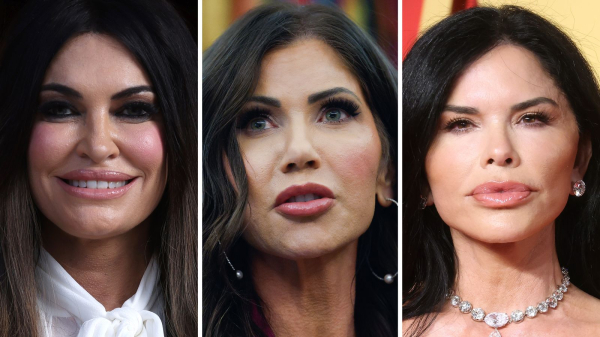
Aesthetic interventions that change contours and erase wrinkles can diminish the cues that signal warmth and wisdom, the very things we rely on a face to communicate. From left: US ambassador to Greece Kimberly Guilfoyle, US secretary of Homeland Security Kristi Noem, Lauren Sánchez Bezos.
Getty images
I wonder if we’ve been in the process of losing the face’s primary function. And whether we’re finally starting to see a real backlash to the prevalence of conformity. There is certainly a roster of celebrities refusing to succumb to extreme facial work—and I might argue this is a result of more of us recognizing the threat to our social harmony and community. As one astute editor at this magazine asks, “going into 2026, maybe it’s not an anomaly to see a woman over 40—or 70—looking her age onscreen?” Stars like Keri Russell, Claire Danes, and Olivia Colman on the younger end; Parker Posey, Robin Wright, and Jodie Foster in the mid-range; more mature luminaries Kathy Bates, Helen Mirren, Catherine O’Hara, and Jean Smart—none of them have taken the Kris Jenner route. That feels like more than just a handful of resistance.
Mar-a-Lago face makes it almost impossible to decipher who’s who in that particular troop.
To get back to the basic question: What’s a face for? Starting with the completely obvious, a face is what enables your friend to pick you out of a crowd (recognition). If you’re a toddler lost in a department store, it allows you to realize with desperate surprise that the adult hand you just grabbed does not belong to the face you trust (bonding resulting from facial attunement). In which case, your face will communicate unequivocally to that strange adult that you are not comfortable with their unfamiliar companionship (communication of emotions). All of which suggests that the human face has evolved to be read. Our physiognomy, including individual asymmetries, our expressions (macro and micro), the qualities of our complexion, all encode valuable information about age, our mental and physical health, our lived experience and personality. What happens when these cues are greatly diminished or erased either by plastic surgery or other aesthetic interventions?
What happens is—among other things I’ll get to in a minute—confusion. Because facial expressions create a feedback loop between people. When expressions are reduced or largely eradicated, communication is distorted. (Watch this video of Botoxed women trying to look angry.) But expressions also initiate emotional feedback with yourself. Smiling can actually lift your mood, while frowning can lower it. This, I now realize, might be why in my 70s I’m suddenly considering my first surgical intervention to modify the unwelcome changes I’ve noticed around my mouth—intensifying my resting bitch face, and so sending distorted feedback about my persistently sunny outlook.
I wonder if we’ve been in the process of losing the face’s primary function.
In fact, the face is so important to our social fabric that there’s an area of the brain—called the fusiform face area—devoted exclusively to decoding it. Damage the cerebral geography here, and you can’t even read the map, losing altogether the ability to recognize faces (prosopagnosia). But here’s what might be the most revealing detail about how your brain reads a face. It’s not by examining it at rest. The brain interprets patterns of movement: tension at the corners of the mouth, a slight widening of the eyes, a lift of the eyebrow. When facial movement looks unusual or inconsistent to what we expect—no matter how “perfect” the face—it makes us feel uncomfortable because the signals we’re getting are degraded and unreadable. Which is when we might begin to feel we’re looking at a person whose primary residence is deep in the Uncanny Valley.
As the options for facial fiddling have become more accessible, the face is increasingly regarded as an image to be perfected. But aesthetic treatments that sharpen the contours of the face—snatching the jaw, inflating the lips—to give them more contrast in photos, can reduce and distort expression. Aesthetic interventions that reduce wrinkles and facial asymmetries like crows’-feet diminish the cues that can signal warmth, wisdom, and happiness, the very things we rely on a face to communicate. There’s even a procedure now designed to diminish or resolve that adorable little pocket some people get just beneath their eyes when they smile. Neurotoxin is injected to relax the muscles under the eyes, reducing the bulging “jelly roll.” I have just one question about this procedure: Why?
When facial movement looks unusual or inconsistent—no matter how “perfect” the face—it makes us feel uncomfortable because the signals we’re getting are degraded and unreadable.
If there’s a trend toward aesthetic procedures that yield more natural-looking results—a prediction that seems to be floating to the top of the 2026 prediction pile—that might make it easier to go even farther than that: rejecting the idea that any aesthetic intervention is inevitable as we age.
After all, similar to how Jessie Buckley uses her face as an artistic instrument, we use ours (often unconsciously) as a social instrument. A face identifies us as a person alive and with presence; a face is irreducibly unique, and yet through it we can trace the bones and beauty of our ancestors. As we age, a face can serve as a lovely, richly imbued representation of past harmonies and discordance—essentially, in the end, a coda to a well-lived life.
About the Author